
我和僵尸有个约会3
美媒BROADROOM统计了现役球员薪资榜单 第一毫无疑问是他_我的网站

一 |
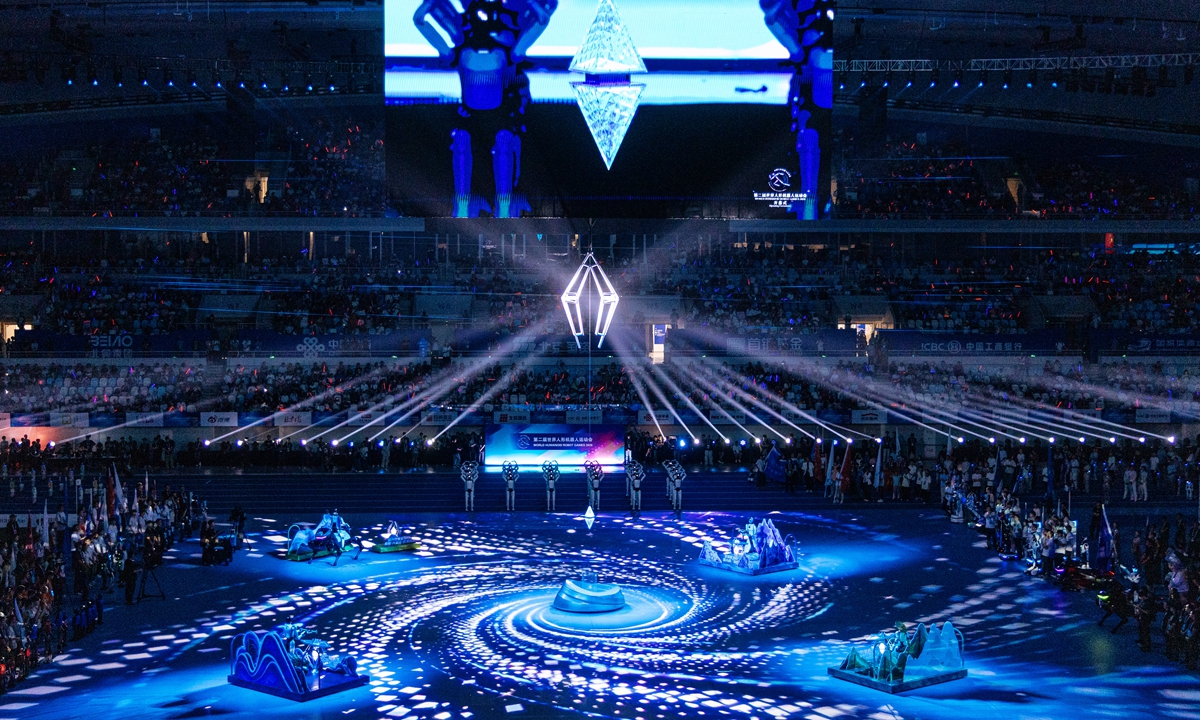
The lights went down inside the National Speed Skating Oval. A humanoid robot riding on a robotic horse, lifted a bow, drew back the string and let the arrow fly.
The arrow found its mark, and the “Zhixin,” or intelligence chip — this competition’s equivalent to the Olympic flame — lit up above the arena. The venue erupted in cheers.
With that, the 2nd World Humanoid Robot Games opened on Saturday at the Beijing venue better known as the “Ice Ribbon” — the capital’s second robotics showcase in a week, following the 2026 World Robot Conference, which opened on August 19.
The opening ceremony began with demonstrations of the 100-meter sprint and the standing high jump. In the sprint, a humanoid robot clocked 9.39 seconds — faster than the men's 100-meter world record of 9.58 seconds set by Jamaican sprint legend Usain Bolt. In the high jump, a humanoid robot reached 288.43 centimeters. Both marks were set by the Tien Kung Ultra humanoid robot by Beijing-based X-Humanoid. Table tennis, tennis, football and other events were then demonstrated jointly by elite human athletes and robots.
The parade of international delegations and robot contingents followed, including formations of humanoid robots from Booster Robotics, Galbot and Noetix Robotics. The robots performed drills as they marched, all of it done autonomously with no remote control.
The X-Humanoid fielded a 50-strong contingent of its Tien Kung 3.0 robots. Tien Kung 3.0 also served as the only robot flag bearer of the games, marching at the head of all contingents while waving the games flag, and it is also the humanoid robot archer who lighted the “Zhixin”, the company told the Global Times.
More than a thousand robots appeared over the course of the ceremony, in a series of joint performances with humans — an opening overture played by humanoid robot musicians alongside a human orchestra, and segments with pop singers, with the judges of the dance events taking the floor themselves, and with children.
Taishan Sports, the Shandong-based official equipment supplier of the games, provided the running tracks, the artificial turf for the football pitches, the floor surfacing for events including the long jump, high jump and weightlifting, and the impact mats that slow the robots down at the end of the sprint lanes.
"Robots are very heavy, and what they need from a surface in terms of hardness and friction is not what a human runner needs, so we adjusted the material formula specifically," Man Fangfang, the vice director of the company, told the Global Times at the venue. The artificial turf was reworked the same way — robots do not play football the way people do, and the turf has to be non-slip and antistatic.
The company spent months talking to the competing teams and retesting the gear before the games. Taishan Sports has supplied equipment to eight Olympic Games and more than 3,000 sporting events, "but this is our first time serving robot games," she said.
China's robotics industry is growing fast and robots are moving into every sector, while the sports industry has always lent itself to crossover with other fields, Man said, adding that the company wants to use the games to work out what equipment suits robots and to develop more of it.
Compared with the first edition, the second games have expanded in both scale and quality. A total of 666 teams and 2,056 robots from 16 countries across six continents are competing, with the number of teams up 138 percent from the first edition and the number of robots quadrupling, according to CCTV.
Competition events have doubled from 26 to 51, while the number of matches has more than doubled from 487 to 1,301. More combative and spectator-friendly events such as martial arts and dance have been added to the competitive program.
Notably, the second games set stricter autonomy requirements for the robots. Except for the 100-meter and 400-meter obstacle races, all track events and other competitive events must be completed by robots fully autonomously. In scenario-based events, a task completed fully autonomously carries a final score weighting coefficient of 1, while one completed by remote control carries only 0.5, per CCTV.
Analysts said the higher bar on autonomy is in line with the industry’s development goal of having robots complete tasks without human operation.
。 美媒曝光了现役薪资排行榜 第一名毫无疑问就是生涯长达24年的勒布朗·詹姆斯 1. 骑士|4年1879万|新秀 2. 骑士|4年6038万|3+1球员选项 3. 热火|6年1.10亿|4+2球员选项 4. 骑士|2年4210万|1+1球员选项 5. 骑士|2年4697万|1+1球员选项 6. 骑士|3年9986万|2+1球员选项 7. 湖人|4年1.533亿|全额保障 8. 湖人|2年8566万|1+1球员选项 9. 湖人|2年1.01亿|1+1球员选项 10.76人|2年800万|1+1球员选项 以5.813亿排名第一 1. 詹姆斯生涯绝大部分合同都带球员选项,掌握离开主动权;只新秀合同没有。 2. 2016工资帽暴涨之后,年薪正式跨过3000万;后期连续5000万+。 3. 多次打完就跳出重签,不执行合同最后一年,利用工资帽上涨拿到更高年薪。

二 | 第二名 凯文·杜兰特 也是极具效率的小前锋 跟詹姆斯平分秋色的联盟大小王之一 生涯薪资也超过了5亿 以5.011亿排名全联盟现役第二 1. 超音速/雷霆|4年1951万|新秀合同 2. 雷霆|5年8916万|全额顶薪 3. 勇士|2年5430万|1+1球员选项(降薪) 4. 勇士|1年3000万|短约 5. 篮网|4年1.64亿|全额顶薪 6. 篮网(带到太阳)|4年1.94亿|提前顶薪续约,末年球员选项 7. 火箭|2年9000万|1+1球员选项(降薪) 阿杜末年仍然手持死神镰刀 中投依旧稳定 是联盟大杀器之一 技术全面 只可惜与詹姆斯的“战斧”以锈迹斑斑 镰刀同样不再锋利 令人唏嘘 希望他能在生涯最后几年 再进一步 第三名 斯蒂芬·库里 1. 勇士|4年1270万|新秀合同(带球队选项) 2. 勇士|4年4400万|提前续约(著名童工合同) 3. 勇士|5年2.01亿|全额顶薪(历史首份2亿合同) 4. 勇士|4年2.15亿|提前顶薪续约 5. 勇士|1年6260万|短约 6. 勇士|2年1.367亿|顶薪续约,末年球员选项 库里生涯极具戏剧性 生涯前期由于身材矮小 美国排行名单过于靠后 没有状元郎詹姆斯和榜眼秀杜兰特那么耀眼 所以生涯前期一直在拿着底薪的童工合同 但是他开创的小球时代对于NBA历史来说是极具代表性和标志性的 以4.701亿排名第三 剩余的 詹姆斯·哈登4.116亿 保罗·乔治 4.602亿 克里斯·保罗4.045亿 科怀·伦纳德3.757亿 吉米·巴特勒3.661亿 达米安·利拉德3.653亿 安东尼·戴维斯3.644亿 他们的时代即将过去 如果他们退役了 NBA一个时代的门面就将落下帷幕。
Current article:http://sypba.dinggaxilianmaiyuejienianguai.shop/news/20260826_61850.html
Published on:21:19:57